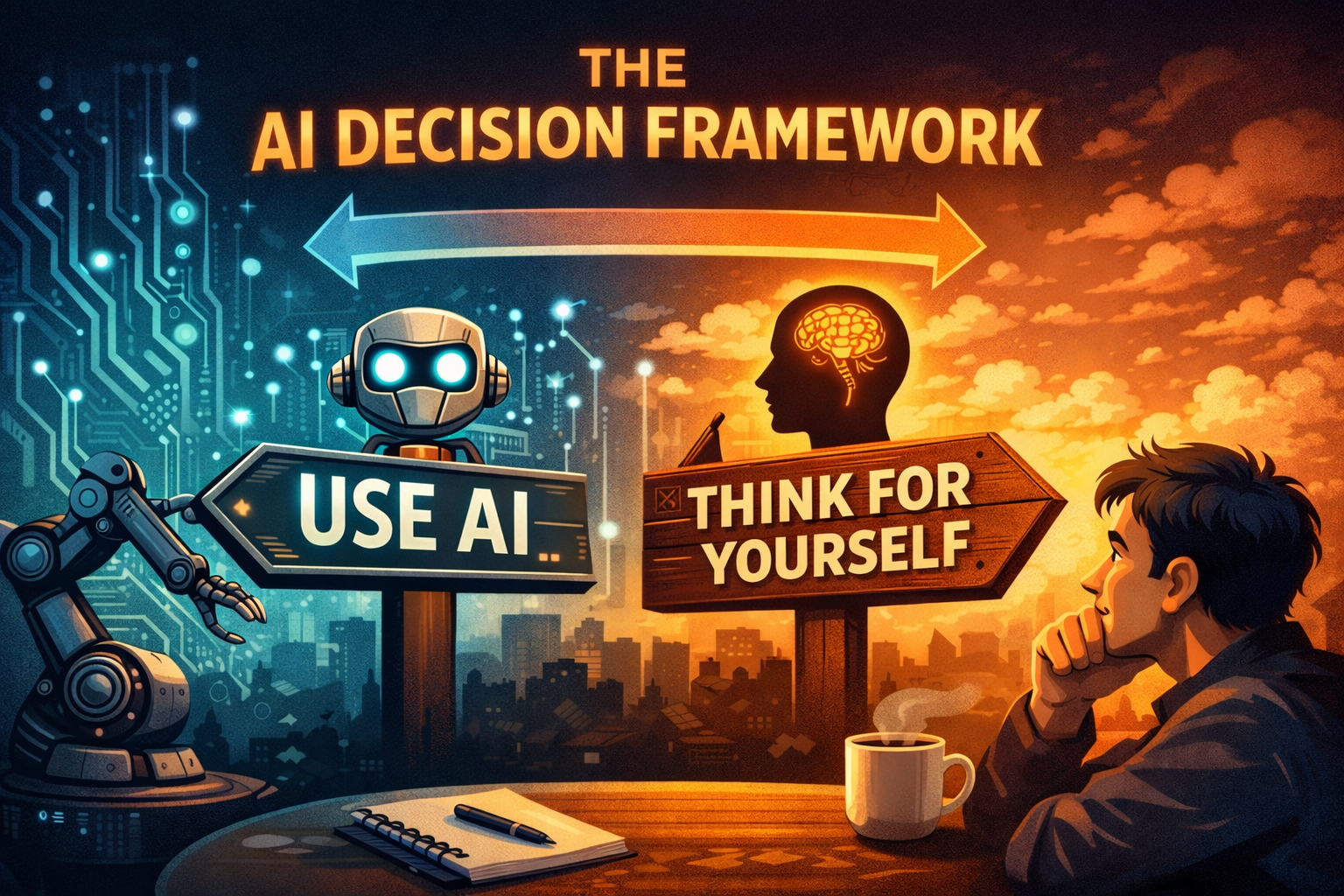
The AI Decision Framework: When to Use AI vs When to Think for Yourself
I watched a colleague spend fifteen minutes crafting the perfect prompt to ask ChatGPT how to respond to a simple email last week. The irony? Writing the response himself would've taken three minutes.
This is the new productivity paradox. We have incredible AI tools at our fingertips, but we're not always using them wisely. Some people avoid AI entirely, afraid of becoming dependent. Others use it for everything, even decisions that take longer to outsource than to make themselves.
The real skill isn't just knowing how to use AI. It's knowing when to use it.
The Coffee Shop Decision Framework
Think about your relationship with coffee shops. You don't go to a café every single time you want caffeine. Sometimes you brew at home. Sometimes you grab instant. Sometimes you need that artisan pour-over.
The decision depends on what you're optimizing for: time, quality, cost, or the experience itself.
Your relationship with AI should work the same way. It's not about always using it or never using it. It's about matching the tool to the task.
When AI Actually Helps You Win
AI excels at specific types of work, and recognizing these patterns will save you hours every week.
Use AI when you're dealing with high-volume, low-stakes tasks. Drafting ten variations of a social media post. Summarizing long documents. Generating initial ideas for a project name. These are perfect AI tasks because mistakes are cheap and iteration is fast.
Use AI when you need to overcome blank page syndrome. Starting is often harder than refining. Let AI give you a rough draft, a basic outline, or a few options to react to. Your editing brain is usually sharper than your creating-from-nothing brain.
Use AI when you're working outside your expertise. Need to write code but you're a marketer? AI can bridge that gap. Want to understand a legal document? AI can break it down into plain language. It's like having a knowledgeable friend who can translate specialized knowledge.
Use AI for pattern recognition at scale. Analyzing trends across hundreds of customer reviews. Spotting inconsistencies in data. Finding themes in research. AI processes volume better than human attention spans ever will.
When Your Brain Beats the Machine
Here's what many people miss: there are tasks where using AI actually makes you slower and worse.
Think for yourself when the task requires deep contextual understanding. AI doesn't know your company culture, your boss's pet peeves, or the subtext of that meeting last Tuesday. A recommendation that looks good on paper might be politically disastrous in your specific situation.
Think for yourself when you need genuine creativity and originality. AI remixes existing patterns. It can't create truly novel connections the way human insight can. If you're developing a unique strategy or innovative solution, AI gives you the average of what's been done before, not what's never been tried.
Think for yourself when the thinking IS the value. Working through a complex problem develops your expertise. Delegating every challenging task to AI is like taking the elevator every time - convenient now, but you're not building any strength. Some mental heavy lifting makes you better at your job.
Think for yourself when stakes are high and trust matters. Important client relationships. Sensitive personnel decisions. Strategic pivots. These moments require judgment, empathy, and accountability that AI can't provide. People know when they're getting the AI version of you.
The Quick Decision Test
Before reaching for AI, ask yourself three questions:
Does this task build skills I need? If yes, do it yourself. The temporary efficiency of AI isn't worth long-term skill atrophy.
Would explaining my context to AI take longer than just doing it? If yes, just do it. Not everything needs to be optimized.
Do I need to own this decision completely? If yes, AI can inform you, but you need to think it through yourself.
If you answered no to all three, AI is probably your friend here.
What This Looks Like in Practice
Let's make this concrete. Here's how this framework plays out in real work:
Email responses: Routine updates and scheduling? Let AI draft it. Sensitive feedback or relationship building? Write it yourself.
Research: Initial literature review and summarization? Perfect for AI. Synthesizing insights and forming conclusions? That's your job.
Content creation: Social posts and first drafts? AI can help. Your unique perspective and final voice? All you.
Problem-solving: Generating solution options and checking your thinking? Great AI use. Making the final call with incomplete information? Human territory.
Learning: Getting explanations of concepts? AI is brilliant here. Developing true mastery through practice? Can't be outsourced.
The Real Risk Nobody Talks About
The biggest danger isn't AI dependence. It's outsourcing the wrong things and keeping the wrong things in-house.
I've seen people spend hours manually reformatting data that AI could handle in seconds. I've also seen people use AI to write performance reviews that felt hollow and damaged trust.
The cost isn't just efficiency. It's the slow erosion of your judgment about what matters and what doesn't.
Building Your AI Instinct
Here's the good news: this gets easier with practice. Start noticing your AI usage patterns this week.
When you reach for AI, pause and ask: "Am I using this because it's actually better, or because I'm being lazy?" Both answers are sometimes okay, but you should know which one it is.
When you avoid AI, ask: "Am I doing this myself because it matters, or because I'm being stubborn?" Again, both can be valid, but awareness matters.
The goal isn't to optimize every single decision. It's to develop an instinct for when to collaborate with AI and when to trust yourself.
The Bottom Line
AI isn't replacing thinking. It's changing which types of thinking are valuable.
Routine cognitive work is increasingly automated. That means human judgment, contextual understanding, and genuine creativity are becoming more valuable, not less.
The people who win in this new landscape aren't the ones who use AI most or least. They're the ones who know the difference.
They use AI to handle the volume so they can focus on the value. They let AI do the heavy lifting so they can do the deep thinking. They treat AI as a tool that enhances their judgment, not replaces it.
Start small this week. Pick one task you've been doing manually that AI could handle. And pick one task you've been giving to AI that deserves your actual thinking.
You'll be surprised how much both decisions matter.
See you next week. Bring your coffee and your judgment.